Complete crawlable web edition
Are Your Operations Costing You Money?
The full guide to finding hidden operational costs and choosing a practical place to improve.
Read all eight sections, work through five reusable worksheets, and use the research notes and 30-day plan with your team.
- Eight practical sections
- Five worksheets
- Four research deep dives
- 30-day action plan
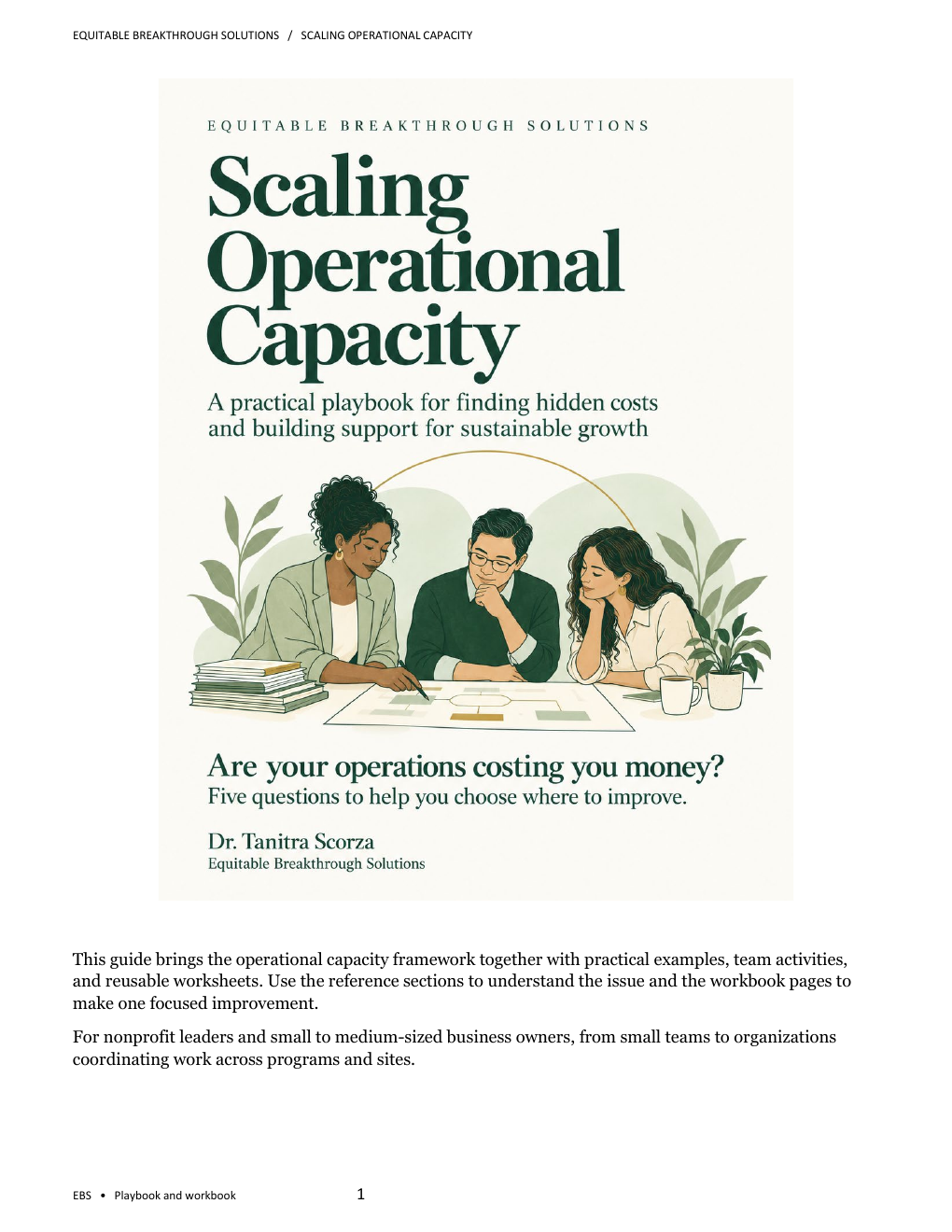
Operational capacity is the support that helps your organization do its work reliably and adapt when needed. It includes clear responsibilities, usable information, workable processes, appropriate tools, and enough time to follow through. To strengthen it, start with one recurring piece of work that your team struggles to carry reliably. Clarify who owns it, what information and support people need, and how you will know whether a small change helps.
This complete web edition brings the EBS operational capacity framework together with practical examples, team activities, reusable worksheets, and optional research deep dives. It is for nonprofit leaders and small to medium-sized business owners, from small teams to organizations coordinating work across programs and sites.
Download the illustrated playbook and workbook (PDF, 56 pages).
Workbook examples are fictional learning scenarios. Adapt the tools to your governance, contracts, service requirements, and available resources. The examples do not represent documented client results.
How to use this guide
Follow the practical sections and workbook activities to choose one improvement and put it to work. If you want to explore the evidence, use the research deep dives near the end. Each explains the finding, its practical use, and its limits.
| Your starting point | Where to work |
|---|---|
| Understand the value of operational support | Sections 1 and 2 |
| Match support to your organization | Section 3 and Workbook Move 1 |
| Share responsibility and decisions | Section 4 and Workbook Move 2 |
| Improve a workflow or onboarding | Section 5 and Workbook Moves 3 and 4 |
| Balance consistency and judgment | Section 6 |
| Measure progress and plan the next month | Section 7 and Workbook Move 5 |
| Address wider constraints | Section 8 and the closing action page |
| Explore research or calculate a measure | Research Deep Dives A through D |
Before you begin
Improvement work needs a safe and realistic starting point.
Pause for immediate risks. Is there an immediate concern involving payroll or cash, safety, client care, data access, or a required deadline? Assign an accountable person and seek the relevant financial, legal, HR, or service expertise. Do not wait for a worksheet cycle to address an urgent risk.
Separate the issue from its surroundings. Ask what you can change internally, what needs more resources, and what depends on an outside decision. A late reimbursement, an underfunded contract, or a staffing shortage may require negotiation, revised commitments, or added funding alongside process improvements.
Agree on the scope.
- Choose a recurring task or decision rather than an entire department.
- Protect time for the people who will help improve it.
- Use fictional or de-identified details when discussing client examples.
- Name what is already working and should be preserved.
Write down the immediate concern, who will address it, and what you can realistically improve during the next 30 days.
A message from Dr. Tanitra Scorza
You have plans for your organization. You also have questions to answer, decisions waiting, and work that keeps finding its way back to you. You care about your mission and your people, yet the support behind the work may not have kept pace with what the organization now needs to carry.
Operational pressure often points to a need for clearer roles, more reliable workflows, shared knowledge, or additional resources. This guide helps you identify that need and build practical support, one focused improvement at a time.
Use the framework to understand the work and the workbook activities to make it concrete. Start with one area. Involve the people doing the task and decide what would make the work easier to carry.
Operations and support
Operational capacity is the support that helps your organization do its work reliably. Funding and committed people matter. They also need ways of working that help them turn those resources into dependable service.
Having a tool is different from being able to use it well. A shared database may be in place while staff still need clear instructions, access, practice, and an agreed handoff. Capacity includes that practical support.
Start with a simple question: What would help people complete this work consistently, including when something changes?
Look beyond the presence of a policy, platform, or training. Ask whether people can find the information, understand their responsibility, make the next decision, and get help when an exception appears. A system is useful when the surrounding conditions make it usable.
How operational support creates value
Operational support changes the everyday conditions of work first. People know who owns the next step, have the information they need, and spend less time waiting or correcting mistakes. These improvements can make service more dependable and strengthen the experience of staff, clients, and partners. Longer-term results also depend on funding, demand, and conditions outside the organization.
Look for value in five connected areas. You do not need to improve all five at once.
Protect money and time
Clear intake, timekeeping, invoicing, and cash reviews help you see what is owed, avoid preventable corrections, and plan what the organization can afford. Research links stronger management practices with better business results, although results vary by setting.
Examine where information must be corrected, where approvals wait, and where staff enter the same information more than once. These are not merely inconveniences. They consume paid time and can delay billing, reimbursement, decisions, or service.
Make service dependable
Agree on what people can expect, what good work looks like, and how staff should respond when something falls outside the usual process. Check both staff effort and the experience of the person receiving service. A faster internal process is not helping if it creates longer waits, more errors, or repeated explanations for clients.
Support the people doing the work
Clear roles, realistic workloads, useful onboarding, and prepared backup make responsibility easier to carry. Training or wellness support may help when questions, corrections, and coverage gaps keep returning. They may need to be paired with clearer handoffs, manageable workloads, and resources to provide coverage.
Turn plans into follow-through
Name the next action, its owner, the support needed, and a review date. Consistent communication and fulfilled commitments help build trust with staff, funders, clients, and partners. A plan becomes operational when people can connect it to decisions and routines during the workday.
Protect continuity and mission
Appropriate financial checks, secure information, and backup arrangements help protect the work. Administrative support also takes resources. A low overhead percentage alone cannot tell you whether an organization is effective. The relevant question is whether the organization has enough appropriate support to fulfill its commitments responsibly.
Match structure to organizational complexity
The support your organization needs depends on how the work is connected. A small team may need a few clear agreements. An organization with several programs or sites may need shared standards, supervisors, and more deliberate coordination. Add structure where it solves a real problem.
Use these staff ranges as conversation starters. Contractors, sites, service risk, funding requirements, and handoffs may matter as much as employee count. These are planning guides, not validated thresholds.
| Staff range | Support to consider | Watch for |
|---|---|---|
| Fewer than 5 | Know the money position; agree on decisions; keep key information accessible; prepare backup. | Large policy libraries or tools the team cannot maintain. |
| 5 to 9 | Clarify roles; use shared workflows and onboarding; review workload and payment deadlines. | Approval layers that add waiting without a useful check. |
| 10 to 24 | Name supervisors and process owners; improve handoffs; keep records and quality checks consistent. | Complex software or role boundaries that make coordination harder. |
| 25 to 49 | Support managers; share decisions; connect budgets, staffing, vendors, and continuity planning. | Returning every exception to the executive or using one approach for every program. |
| 50 to 250 | Coordinate programs and sites; connect systems; review risks, quality, and change across teams. | Duplicate reporting and routines that no longer help the work. |
Use size as one signal, then ask about complexity. A five-person organization managing multiple restricted contracts, sensitive client information, and several service partners may need stronger controls than a larger team with one straightforward service.
Workbook Move 1: from repeated questions to a clear need
Illustrative scenario: a community nonprofit with eight staff
New program staff regularly ask the director whether a referral is ready to assign. The director answers each time, but assignments slow down when she is in meetings.
| What the team notices | What they learn |
|---|---|
| The director receives similar questions each week. | Required referral information is not listed in one place. |
| Staff send different details for review. | There is no shared definition of “ready to assign.” |
| The director decides every case. | Routine assignments and exceptions have the same approval path. |
The priority they choose: Make routine referrals ready for assignment without requiring the director to review each one.
Their first test: Create a short readiness checklist with the intake coordinator. Clarify which exceptions need consultation. Test it on the next small set of referrals and review any cases that still get stuck.
What they will watch: Missing information, time waiting for a decision, and whether staff can explain when to ask for help.
Worksheet 1: choose your first priority
Bring two or three recent examples. Describe what happened before deciding why.
- What keeps returning or getting stuck?
- What happened in a recent example, and what effect did it have on the work?
- What is already helping?
- Who should help us understand the issue?
- What is our best current explanation, and what do we still need to check?
- What is our first priority?
Check the priority before continuing: Is it recurring? Does it matter? Can you influence it? Is it small enough to test?
Share responsibility and reduce leader dependence
As an organization grows, decisions, relationships, and knowledge can remain concentrated in one leader. That leader may be carrying fundraising, finance, people support, service quality, and daily problem solving at the same time. The question is where the work now needs shared ownership and better support.
A quick conversation may have been enough when the team was smaller. More programs, clients, and reporting requirements can make the same approach harder to sustain. Notice which routine decisions keep returning and what people need to handle them confidently.
You do not have to carry every part of the work alone. Clear ownership, shared knowledge, useful tools, and the right support can make responsibility easier to share.
When knowledge and authority remain concentrated, work can wait for one person’s availability. People may hesitate to act when their authority is unclear. Shared guidance, decision boundaries, and prepared backup help distribute responsibility.
For one recurring responsibility, agree on four things:
- Decision boundaries. Name what the owner can decide, when to consult someone else, and what still needs approval.
- A usable role agreement. Record the main responsibilities, expected results, decisions, and handoffs. Make it short enough to use during the work.
- A clear handoff. Agree on what must be passed along, where it belongs, and what happens when information is missing or a case needs a different response.
- Checks that fit your team. Keep appropriate financial oversight when several duties sit with one person. Agree with your financial or governance support on checks such as independent review, payment approvals, and transaction alerts.
Workbook Move 2: make routine decisions easier
Illustrative scenario: a small professional service firm
The owner approves nearly every appointment change. The coordinator knows the schedule but is unsure which changes affect staffing or client commitments.
| Decision | Coordinator can | Bring in the owner when |
|---|---|---|
| Move an appointment | Reschedule within approved hours and existing capacity. | The change requires added staffing or an exception to a service agreement. |
| Fill an opening | Offer an available slot using the agreed scheduling rules. | A priority conflict cannot be resolved using those rules. |
| Respond to a service concern | Acknowledge it and document the concern using the agreed process. | There is a safety issue, contractual concern, or request beyond assigned authority. |
The handoff agreement: Record changes in the shared schedule. Flag unresolved exceptions through the agreed channel. The owner names a backup for periods when they cannot respond.
The team checks: Does the coordinator have access, time, and enough examples to use the boundaries confidently? Are clients receiving accurate information?
Worksheet 2: responsibility and decision guide
Complete this for one recurring responsibility. Review it with the owner and backup.
- Responsibility and expected result
- Owner and prepared backup
- The owner can decide independently when...
- Consult before proceeding when...
- Approval is required when, and from whom...
- The next person needs this information by this point...
- Access, training, time, or other support needed
- People who reviewed the agreement
- Review date
A practical roadmap for operational improvement
Begin with the work that needs support now. Complex software or a new dashboard may add effort if roles, steps, and information are still unclear. The ten priorities below provide a planning route. Adapt the starting point and pace to your circumstances, and address urgent financial, safety, or compliance concerns immediately.
Phase 1: stabilize the foundation
1. Know your financial position. Keep bookkeeping current. Review available cash, upcoming payments, money owed to you, and spending against the budget. Understand the full cost of the services you deliver. This helps distinguish a workflow issue from a funding, pricing, or payment problem before committing to more work.
2. Agree on the promise and priorities. Name who you serve, what they should be able to expect, and what matters most now. Agree on work you will defer or stop. A smoother process should help you deliver something meaningful, not simply move activity faster.
3. Clarify roles and decisions. Record responsibilities, expected results, decision boundaries, consultation paths, approvals, and backup. Responsibility without authority, access, knowledge, or time is not shared ownership.
Phase 2: make delivery dependable
4. Improve critical workflows. Map one recurring piece of work from request to completion. Clarify the owner, needed information, ready condition, exception path, and record location at each handoff.
5. Make workloads manageable. Review demand, staffing, coverage, and recurring overtime or interruption. Ask what should be stopped, rescheduled, simplified, reassigned, or funded. Do not use individual resilience as a substitute for adequate capacity.
6. Put safeguards where they matter. Protect cash, sensitive information, client care, required approvals, and business continuity. Controls should reduce meaningful risk without creating unnecessary waiting.
7. Use measures that support decisions. Choose a small number of measures tied to questions the team must answer. Include guardrails for quality, equitable access, privacy, and workload.
Phase 3: prepare to adapt and grow
8. Check technology fit. Clarify the workflow, ownership, information, and review process before automating. Consider the full effort required for configuration, migration, access, training, support, and maintenance.
9. Test and learn. Try a limited change, record what happens, and decide what to keep, adjust, test again, or stop. A stopped test can be useful learning when the evidence shows that the change is not helping.
10. Review growth readiness. Before adding a grant, contract, program, location, or employee, identify the support required across finance, staffing, supervision, information, quality, and continuity. Growth creates new coordination work even when demand and funding are strong.
Workbook Move 3: improve one referral handoff
Illustrative scenario
A program team receives referrals by email, phone, and shared spreadsheet. Staff spend time checking whether eligibility and consent information are present. Referrals move between people without a consistent ready point, so incomplete cases return for clarification.
The team follows several recent referrals from start to finish. They separate time spent working from time spent waiting and identify the handoff where missing information most often causes rework.
Their first improvement is not a new platform. They agree on required information, name who checks it, define when a referral is ready to assign, and identify an exception route for unusual or urgent cases. They test the agreement on a limited set and review any referral that still gets stuck.
Worksheet 3: map and improve one workflow
Choose a recurring workflow and map it with the people sending and receiving the work.
| Step | Owner | Information or handoff needed | Ready when |
|---|---|---|---|
| 1 | |||
| 2 | |||
| 3 | |||
| 4 |
Then discuss:
- Where does work wait?
- Where does information arrive incomplete?
- Where is information entered more than once?
- Which step depends on one person?
- Which exception needs a different path?
- What standard must remain consistent?
- What can staff adapt using judgment?
- What is the smallest useful change to test?
For a deeper workflow exercise, read How to Identify and Fix Workflow Bottlenecks.
Workbook Move 4: make onboarding usable across sites
Illustrative scenario
A growing organization operates across several sites. Each site introduces new employees differently. Some managers provide useful practice and examples; others rely on policy documents and informal explanation. New employees receive inconsistent information about priorities, client interactions, records, and escalation.
The organization identifies essential expectations that should be consistent across sites while leaving room for local schedules, relationships, and context. It connects the shared learning sequence to manager check-ins, supervised practice, access to tools, and evidence that the employee can carry key responsibilities.
The team does not treat attendance or content completion as proof of readiness. Managers use common observation points and discuss where a new employee can work independently and where additional support is needed.
Worksheet 4: plan support behind the task
Choose one responsibility that a staff member must learn or carry reliably.
| Support area | Questions to answer |
|---|---|
| Clear expectation | What result should the person produce? What does good work look like? |
| Access and tools | What system, information, permission, equipment, or template is needed? |
| Example | Can the person see a realistic completed example? |
| Practice | Where can they try the work with limited risk? |
| Feedback | Who observes, answers questions, and corrects misunderstandings? |
| Decision boundary | What can they decide, and when should they consult or seek approval? |
| Workload | Is there enough time and coverage to learn and perform the task? |
| Backup | Who else is prepared to carry the work? |
| Readiness evidence | What would show that the person can perform the responsibility? |
Training is one form of support. It cannot compensate for missing authority, unclear expectations, inaccessible information, unmanageable workload, or a broken handoff.
Use enough structure and enough judgment
The goal is not to document everything. It is to create enough shared structure for important work to be dependable while preserving appropriate judgment.
Written guidance is especially useful when:
- the task happens repeatedly;
- several people must coordinate;
- a mistake would affect safety, cash, privacy, compliance, or service quality;
- a new person needs to learn the work;
- the work must continue during an absence;
- people disagree about the expected result or next step.
Use judgment when circumstances differ in ways a general procedure cannot fully anticipate. Make the boundary visible: identify what must remain consistent, what can be adapted, and which exceptions require consultation or approval.
Review guidance after a meaningful change, repeated correction, service concern, near miss, technology change, staffing shift, or contract update. Also schedule a routine review so obsolete instructions do not remain in circulation.
Reduce reporting burden and duplicate data work
Before adding a field, dashboard, or report, ask:
- Who uses this information?
- What decision does it support?
- Is the same information already collected elsewhere?
- Who is responsible for accuracy and correction?
- What burden does collection place on staff or clients?
- Can the requirement be simplified, combined, or removed?
Data work can become fragmented when funders, systems, and teams require different definitions or formats. Clarifying the human workflow is a prerequisite for responsible automation. Name what information is needed, who owns each step, where review is required, and how staff will sustain the process over time.
Measure learn and decide
Measures are useful when they help the team answer a question and make a decision. Begin with the question, not the dashboard.
| Question | Possible measure | Decision it can support |
|---|---|---|
| Are handoffs improving? | Work completed without correction; missing-information count; waiting time. | Keep, adjust, or replace the handoff agreement. |
| Is responsibility becoming easier to share? | Decisions completed within the agreed boundary; critical processes with prepared backup. | Add practice, access, clarification, or backup. |
| Is onboarding supporting readiness? | Time to demonstrated role proficiency; check-in themes; supervised-practice results. | Change sequence, manager support, or practice opportunities. |
| Is workload manageable? | Overtime, unplanned absence, caseload distribution, demand within planned capacity. | Reallocate, reduce, reschedule, hire, or renegotiate. |
| Is the organization financially ready? | Cash forecast, receivables aging, billing lag, full service cost. | Pace growth, collect funds, revise pricing, or renegotiate terms. |
Interpret operational measures alongside service quality, access, staffing, and funding. There are no universal cutoffs in this guide.
Workbook Move 5: test one change for 30 days
Illustrative scenario
A team has identified repeated delays in a routine approval. Rather than redesigning the entire process, it tests one decision boundary and one complete-request checklist for 30 days.
During the first week, the team reviews recent examples and records the starting point. During the second, it prepares the agreement, tool, access, and practice. During the third, it tests within a defined scope and records questions. During the fourth, it reviews the evidence and decides what to keep, adjust, test again, or stop.
Worksheet 5: your 30-day action plan
| Week | Focus | Actions |
|---|---|---|
| Week 1 | Understand | Review recent examples. Involve the people doing the work. Record the current condition. |
| Week 2 | Prepare | Build the simplest useful tool or agreement. Confirm access, practice, and backup. |
| Week 3 | Test | Use the change in a limited setting. Record questions, exceptions, and guardrail effects. |
| Week 4 | Review | Compare what happened with the starting point. Decide what to keep, adjust, retest, or stop. |
Complete the plan:
- Priority we are addressing
- Change we will test
- People involved
- Scope and start date
- Measure and data source
- Service, access, privacy, quality, or workload guardrails
- Review date
- Person responsible for updating the shared tool or routine
- Decision after the review
Respond to advice and external constraints
Common operational advice can be useful, but only when it fits the organization’s circumstances. Ask these questions before acting.
1. Do we need more written guidance?
Write guidance when repeated work, coordination, risk, onboarding, or continuity requires a shared reference. Do not create a large policy library the team cannot maintain. Use the shortest form that makes the work clearer: a checklist, decision guide, annotated example, template, or process map may be enough.
2. Are we ready to grow?
Growth is not simply more volume. It increases coordination across staffing, supervision, finance, information, quality, facilities, partners, and leadership. Clarify the full support cost and the organization’s ability to absorb change before making the commitment.
3. Will technology reduce work?
Consider the total effort. Configuration, migration, cleanup, access, integration, training, support, privacy, and maintenance all require capacity. Technology can reinforce a clear workflow, but it can also make an unclear process faster, more rigid, or more difficult to correct.
4. Are plans connected to daily work?
Translate priorities into decisions, owners, milestones, resources, and review routines. Ask what current work should stop or change. Planning is useful when it changes how the organization allocates attention and resources.
5. Does funding support the real cost?
Compare revenue with the full operational cost, timing, restrictions, reporting burden, and working-capital requirement. A funded program can still strain the organization if payment is delayed or essential support is excluded.
6. Does the funding source create concentration risk?
Review dependence on one funder, customer, contract, or reimbursement source. Diversification is not automatically beneficial if it creates many small, misaligned obligations. Consider reliability, restrictions, relationships, and administrative burden.
7. Will a dashboard improve a decision?
Name the user, question, frequency, and decision before designing the dashboard. Remove measures that no longer inform action. A dashboard is not a substitute for discussion, interpretation, or authority to respond.
Wider constraints may require a wider response
Underfunded contracts, delayed payments, staffing shortages, reporting requirements, facilities, transportation, connectivity, and unmet community needs are not problems a checklist can solve by itself. Operational improvement may need to be paired with negotiation, advocacy, revised service commitments, partnership, additional funding, or specialist support.
Resilience is not the ability to absorb unlimited pressure. It includes reserves, relationships, learning, adaptation, continuity arrangements, and the ability to make realistic choices about what the organization can carry.
Put the guide to work
Choose one recurring task or decision. Involve the people closest to it. Clarify the result, owner, information, decision boundary, support, and measure. Test one practical change for 30 days. Then decide what to keep, adjust, test again, or stop.
Equitable Breakthrough Solutions helps nonprofits and small businesses strengthen role clarity, workflows, onboarding, team development, and implementation. See the approach in practice in the SOP and Workflow Documentation System case study, the Employee Onboarding and Staff Readiness case study, and the Leadership Retreat to Implementation Roadmap case study.
Research deep dives
The research sections provide context for readers who want to examine the evidence and its limits. The strongest intervention evidence in this playbook comes from business settings. Several nonprofit findings are observational. The visual guides and workbook tools are practice-informed adaptations. Use study results to inform a question, not to promise an outcome.
Research Deep Dive A: operational value
Researchers have examined management practices, business training, service quality, turnover, onboarding, planning, governance, and nonprofit effectiveness.
A randomized study of Indian textile plants reported a 9.4 percent increase in output and a 16.6 percent increase in productivity after an intensive management intervention. The researchers estimated an annual profit effect of about $325,000 per plant. This is a study-specific author estimate in manufacturing, not a forecast for a nonprofit, service firm, or EBS engagement.
A World Bank reassessment of small-business training evidence reported average improvements of 10.1 percent in profits and 4.7 percent in sales across the reviewed studies, with substantial variation by context and program. These averages do not imply that a particular training will produce the same result.
A service-quality meta-analysis included 86 articles, 115 independent samples, and 42,877 customers. It found relationships among service quality, satisfaction, loyalty, and purchase intention. Service quality and internal efficiency should be considered together; moving work faster is not useful if quality or access declines.
A turnover meta-analysis covering 110 samples and 120,066 observations reported a negative relationship between turnover rates and organizational performance (r = -0.15). A nonprofit human-services study found that onboarding practices were associated with a 2.4 percentage-point decrease in voluntary turnover. These are associations and do not establish that onboarding alone caused the change.
A Bayesian meta-analysis of team planning included 33 samples and found a positive relationship with team performance (r = .31). A study of 240 YMCA organizations also examined formal planning and performance. Planning should be connected to context and implementation; the existence of a plan does not guarantee results.
Detailed value map
| Operational practice | Intermediate effect | Stakeholder experience | Possible downstream value |
|---|---|---|---|
| Current bookkeeping, cash review, accurate invoicing | Better visibility into obligations and receivables | Staff and vendors receive clearer information | Fewer avoidable corrections; more informed commitments |
| Clear service standards and exception paths | More consistent delivery and response | Clients know what to expect | Satisfaction, trust, retention, or contract performance |
| Role clarity, onboarding, supervision, backup | Greater confidence and continuity | Staff receive usable support | Workforce stability and dependable service |
| Owners, milestones, resources, and review dates | More reliable follow-through | Partners see commitments carried forward | Trust and strategic progress |
| Financial checks, secure access, continuity plans | Reduced exposure and faster response | Stakeholders experience responsible stewardship | Protection of mission, assets, and reputation |
These pathways are conceptual. Funding, demand, labor conditions, policy, community needs, and other external factors also shape results.
Research Deep Dive B: growth and support needs
Organizational growth changes coordination. Employee count is visible, but other factors can be equally important: program variety, number of sites, contractor dependence, service risk, funding restrictions, data sensitivity, partner handoffs, and leadership structure.
Use the staff ranges in Section 3 as prompts rather than thresholds. Ask:
- How many distinct programs, sites, funding streams, or customer promises must be coordinated?
- How many handoffs cross teams or organizations?
- Which decisions still depend on one person?
- What risks require independent review or specialist expertise?
- Can managers support staff, interpret standards, and resolve ordinary exceptions?
- Can financial and information systems produce timely, usable records?
- What must remain consistent across the organization, and what should adapt locally?
Glossary
| Term | Working meaning in this playbook |
|---|---|
| Operations | The recurring work through which the organization turns resources into services, products, commitments, and learning. |
| Operational capacity | The responsibilities, information, processes, tools, time, and support that help people deliver reliably and adapt. |
| Organizational capacity | The broader ability to fulfill mission or strategy, including leadership, governance, people, finances, relationships, and operations. |
| Management capacity | The ability to set direction, allocate resources, support people, make decisions, and coordinate performance. |
| Administrative capacity | The support required for finance, HR, compliance, reporting, records, and other organizational obligations. |
| Infrastructure | The underlying systems, roles, tools, relationships, and resources that make work possible. |
| Operational efficiency | The relationship between resources used and work produced, interpreted alongside quality, access, and workload. |
| Performance | Progress and results relative to defined responsibilities, commitments, and outcomes. |
| Value | Benefits created for clients, staff, partners, funders, owners, and mission, including benefits that are not purely financial. |
Research Deep Dive C: structure and investment fit
Structure and controls should respond to meaningful risk and coordination needs. More formality is not automatically better.
An analysis using IRS Form 990 data for 274,352 nonprofits from 2020 through 2022 found an association between independent audits and lower reported fraud. The study’s narrative and table report slightly different odds ratios, so this playbook does not quote an exact estimate. The finding is observational and does not establish that an audit by itself prevents fraud.
A study of Habitat for Humanity affiliates from 2010 through 2016 reported positive relationships among overhead expenses, home construction, and revenue, with diminishing returns above roughly 15 percent in that setting. The result is not a universal overhead target. It illustrates why administrative investment and effectiveness should be examined in context.
Nonprofit and service-business comparison
| Operational dimension | Nonprofits | Service SMEs | What transfers |
|---|---|---|---|
| Purpose and performance | Mission outcomes, public value, and financial sustainability are multi-dimensional. | Commercial results are often more immediate and quantitative. | Clear responsibilities, workflows, and financial visibility transfer; outcome definition differs. |
| Equity obligations | Central to mission fulfillment, public trust, and community legitimacy. | Often driven by legal compliance, brand strategy, or corporate responsibility. | Efficiency and automation still require review for equitable access and client burden. |
| Financial constraints | Restricted funding, reimbursement delays, administrative caps, and tight working capital. | Owner capital, credit, pricing flexibility, demand, and receivables. | Cash forecasting transfers; allowable-cost and revenue-flexibility rules differ. |
| Workforce logic | Mission motivation can coexist with lower pay, emotional labor, and heavy caseloads. | Labor cost, billable utilization, sales productivity, and talent acquisition drive performance. | Role clarity, onboarding, supervision, and workload management transfer strongly. |
| Relationship assets | Community trust, lived experience, partnerships, and public legitimacy are core assets. | Customer relationships, referrals, reputation, and brand drive demand. | Relationship management transfers when it extends beyond commercial transactions. |
| Growth and scaling | Expansion may increase mission reach while risking mission drift, unfunded overhead, or instability. | Growth is generally desirable when profitable, financeable, and supported by demand. | Readiness principles transfer; the desirability of volume expansion may not. |
| Quality failure | Can harm vulnerable people or public trust even when revenue is unaffected. | Appears through churn, complaints, refunds, revenue loss, or brand damage. | Quality systems transfer, but risk tolerance may be lower in human services. |
| Decision authority | Shared across executives, boards, committees, funders, and community partners. | Often concentrated in founders, managing partners, or owners. | Decision-rights tools transfer; stakeholder requirements are broader in nonprofits. |
| Reserves and slack | Sometimes misjudged as unused charitable assets despite resilience value. | Working capital reserves are standard financial management. | Liquidity and continuity principles transfer; external expectations differ. |
Research Deep Dive D: use evidence to learn and decide
Researchers have examined performance information, data work, learning, innovation, and management practices. Absorptive capacity is the ability to find useful knowledge, understand it, and put it to use.
A meta-analysis of 145 studies covering 434,985 firms reported a positive relationship between absorptive capacity and innovation (r = .33), with a stronger relationship to commercialization than invention. Research on British small and midsized enterprises associated a one-standard-deviation increase in a management-practice index with approximately 5 percent higher productivity growth.
Make room to use what the team learns. After a training, review, or small test, agree on what will change, who will update the tool or routine, and when you will check it. For each measure, name the question and decision it supports.
These studies do not show that a dashboard or training session will produce a specific gain. A one-standard-deviation change is a difference on a research measure, not a one-percent increase or a single operational improvement. Business innovation findings do not directly establish nonprofit client outcomes.
Measure menu
Choose from this menu only when a measure supports a real decision. Leading indicators show preparation or support. Intermediate indicators show how the work is going. Lagging indicators show results after the work. Guardrails identify quality, access, workload, or other conditions to protect.
| Value domain | Leading indicators | Intermediate indicators | Lagging indicators | Operational guardrails |
|---|---|---|---|---|
| Financial | Days to close; cash forecast completion; percent of services with known full cost; invoice accuracy. | Budget variance; billing lag; receivables aging; utilization; unit cost. | Revenue growth; operating margin; unrestricted surplus; cash runway; renewals. | Do not improve margins by shifting uncompensated work to staff or reducing quality. |
| Service | Current SOP coverage; training completion; shift coverage; scheduled quality reviews. | Cycle time; waiting time; first-pass yield; error rate; complaint resolution time. | Satisfaction; completion; retention; verified deliverables. | Segment by demographics and need to detect exclusion or inequitable waits. |
| Workforce | Role clarity; supervision cadence; onboarding completion; workload review. | Time to proficiency; overtime; caseload dispersion; unplanned absence. | Engagement; burnout; voluntary turnover; vacancy duration. | Do not substitute individual resilience for staffing and sound job design. |
| Strategic | Priorities with owners and milestones; review cadence. | Milestone reliability; decision latency; resource reallocations. | Priority completion; long-term goal attainment; successful scaling. | Treat stopped or redesigned initiatives as learning, not automatically as failure. |
| Relational | Response standards; feedback coverage; partner review cadence. | Inquiry response time; issue closure; referral follow-through. | Trust; referral volume; renewal; funder confidence. | Include non-users, dissatisfied clients, and marginalized groups in feedback. |
| Risk | Risk ownership; access reviews; reconciliations; vendor due diligence. | Exceptions; near misses; unresolved incidents; recovery time. | Audit disallowances; fraud losses; breaches; penalties. | Monitor control burden and approval delay as operational costs. |
| Mission and social value | Logic model clarity; outcome definitions; client participation in design. | Priority-population reach; service dosage; implementation fidelity. | Verified outcomes; equitable access; sustained community-level effects. | Do not substitute easy activity counts for meaningful outcomes. |
| Learning and adaptation | Time protected; employee ideas; after-action reviews. | Tests completed; learning cycle time; findings acted upon. | Adaptation speed; successful innovation; avoided recurring losses. | Distinguish structured testing from endless, ungrounded change. |
Calculation reference
Agree on what is counted, the time period, and the source before comparing results. For ratios, multiply by 100 to report a percentage when appropriate. Use the same definition over time.
Work completed without correction
Calculation: cases completed without correction or rework divided by total cases completed.
Use it to discuss recurring corrections, missing information, unclear steps, or support needs.
Time waiting for a decision
Calculation: median business days between a complete decision request and the final decision.
Separate time waiting for information from time waiting for approval.
Demand within available capacity
Calculation: periods when demand remained within planned capacity divided by periods monitored.
Investigate workload pressure alongside staffing, service quality, and changing demand.
Single-person dependence
Calculation: critical processes only one person can execute or authorize divided by total critical processes.
Identify high-risk tasks that need prepared backup and appropriate access.
Essential components delivered
Calculation: defined essential components delivered as intended divided by total defined essential components.
Record appropriate adaptations so variation is not automatically treated as failure.
Repeated complaints
Calculation: closed complaints tied to a previously identified cause divided by total closed complaints.
Ask whether the underlying issue changed after the first complaint.
Cash runway in months
Calculation: unrestricted cash available for operations divided by average monthly net cash use.
Use a cash forecast when inflows vary. A burn-rate ratio alone may mislead when the organization is not using reserves.
Outcomes relative to cost
Calculation: verified meaningful outcomes divided by full operational cost for the same scope and period.
Include relevant direct and allocated costs. Compare similar services and populations.
References
Numbers in the original illustrated edition link to the sources below. The list prioritizes sources used by this playbook. Entries 23 and 24 provide supplemental context on digital transformation and nonprofit revenue diversification.
- U.S. Department of Health and Human Services, Children’s Bureau. (2017, May). What is organizational capacity and what does it look like in child welfare? Evaluation brief. Developed by James Bell Associates and ICF for the Children’s Bureau.
- Weiner, B. J. (2009). A theory of organizational readiness for change. Implementation Science, 4, 67. https://doi.org/10.1186/1748-5908-4-67
- Bloom, N., Eifert, B., Mahajan, A., McKenzie, D., and Roberts, J. (2013). Does management matter? Evidence from India. The Quarterly Journal of Economics, 128(1), 1-51. https://doi.org/10.1093/qje/qjs044
- McKenzie, D. (2020). Small business training to improve management practices in developing countries: Reassessing the evidence for “training doesn’t work.” World Bank Policy Research Working Paper 9408. https://doi.org/10.1596/1813-9450-9408
- Forth, J., and Bryson, A. (2018). The impact of management practices on SME performance. IZA Discussion Paper 11399. https://docs.iza.org/dp11399.pdf
- Carrillat, F. A., Jaramillo, F., and Mulki, J. P. (2009). Examining the impact of service quality: A meta-analysis of empirical evidence. Journal of Marketing Theory and Practice, 17(2), 95-110. https://doi.org/10.2753/MTP1069-6679170201
- Hofmeister, J., Kanbach, D. K., and Hogreve, J. (2024). Measuring and managing service productivity: A meta-analysis. Review of Managerial Science, 18, 739-775. https://doi.org/10.1007/s11846-023-00620-5
- Park, T.-Y., and Shaw, J. D. (2013). Turnover rates and organizational performance: A meta-analysis. Journal of Applied Psychology, 98(2), 268-309. https://pubmed.ncbi.nlm.nih.gov/23244224/
- Selden, S. C., and Sowa, J. E. (2015). Voluntary turnover in nonprofit human service organizations: The impact of high performance work practices. Human Service Organizations: Management, Leadership and Governance, 39(3), 182-207. https://doi.org/10.1080/23303131.2015.1031416
- Konradt, U., Nath, A., and Oldeweme, M. (2023). Planning and performance in teams: A Bayesian meta-analytic structural equation modeling approach. PLOS ONE, 18(1), e0279933. https://doi.org/10.1371/journal.pone.0279933
- Siciliano, J. I. The relationship between formal planning and performance in nonprofit organizations. Nonprofit Management and Leadership, 7(4), 387-403. https://doi.org/10.1002/nml.4130070405
- Bryson, J. M., Edwards, L. H., and Van Slyke, D. M. (2018). Getting strategic about strategic planning research. Public Management Review, 20(3), 317-339. https://doi.org/10.1080/14719037.2017.1285111
- Jeon, J. (2026). Fraud risk, governance, and crisis: Reassessing internal controls in nonprofits during the COVID-19 pandemic. Journal of Policy Studies, 41(2), 101-120. https://doi.org/10.52372/jps.250226
- Berrett, J. L. (2022). Linking overhead expenses and nonprofit effectiveness: Evidence from Habitat for Humanity. Nonprofit Management and Leadership, 32(4), 509-530. https://doi.org/10.1002/nml.21492
- Mitchell, G. E., and Calabrese, T. D. (2019). Proverbs of nonprofit financial management. The American Review of Public Administration, 49(6). https://doi.org/10.1177/0275074018770458
- Bopp, C., Harmon, E., and Voida, A. (2017). Disempowered by data: Nonprofits, social enterprises, and the consequences of data-driven work. Proceedings of CHI 2017, 3608-3619. https://doi.org/10.1145/3025453.3025694
- LeRoux, K., and Wright, N. S. (2010). Does performance measurement improve strategic decision making? Findings from a national survey of nonprofit social service agencies. Nonprofit and Voluntary Sector Quarterly, 39(4), 571-587. https://doi.org/10.1177/0899764009359942
- Frumkin, P., and Kim, M. T. (2002, Fall). The effect of government funding on nonprofit administrative efficiency: An empirical test. Working Paper OPS-10-02, Harvard University.
- Washington Nonprofits. (2022, March). The nonprofit experience with government contracting: Challenges and recommendations.
- Stötzer, S., Kaltenbrunner, K., Grüb, B., and Martin, S. (2022). Coping with COVID-19: Which resilience mechanisms enabled Austrian nonprofit organizations to weather the pandemic storm? Schmalenbachs Zeitschrift für betriebswirtschaftliche Forschung, 74(4), 497-535. https://pmc.ncbi.nlm.nih.gov/articles/PMC9753074/
- Stettler, T. R., Moosauer, E. J., Schweiger, S. A., Baldauf, A., and Audretsch, D. (2025). Absorptive capacity in a more or less absorptive environment: A meta-analysis of contextual effects on firm innovation. Journal of Product Innovation Management, 42(1), 18-47. https://doi.org/10.1111/jpim.12758
- Jansen, J. J. P., Van den Bosch, F. A. J., and Volberda, H. W. (2006, July). Exploratory innovation, exploitative innovation, and performance: Effects of organizational antecedents and environmental moderators. ERIM Report Series Research in Management, ERS-2006-038-STR. https://repub.eur.nl/pub/7892/ERS-2006-038-STR.pdf
- Sagala, G. H., and Őri, D. (2024). Toward SMEs digital transformation success: A systematic literature review. Information Systems and e-Business Management, 22(4), 667-719. https://doi.org/10.1007/s10257-024-00682-2
- Arceneaux, S. J. (2020). The relationship between government grants and nonprofit revenue diversification. Master’s thesis, University of Alabama at Birmingham.
- Operational Capacity and Organizational Value. (n.d.). Author-supplied integrative evidence review, 38 pages.
- Rewiring for Scale. (n.d.). Author-supplied visual reference deck, 14 pages.
By the way, what might you notice if you looked at your operations through a financial lens? I made a quiz to help you explore that. Take the Operations and Funds Check