Make grant responsibilities visible across your team
A grant ownership map names who is accountable for each grant responsibility, who does the work, and what support and review are needed. Use it to connect finance, programs, development, and leadership from the proposal through closeout.
If reporting deadlines keep becoming last-minute emergencies, start by looking at the handoffs. A report can have a named owner and still be late when program information, expense records, or approval decisions arrive without a shared deadline.
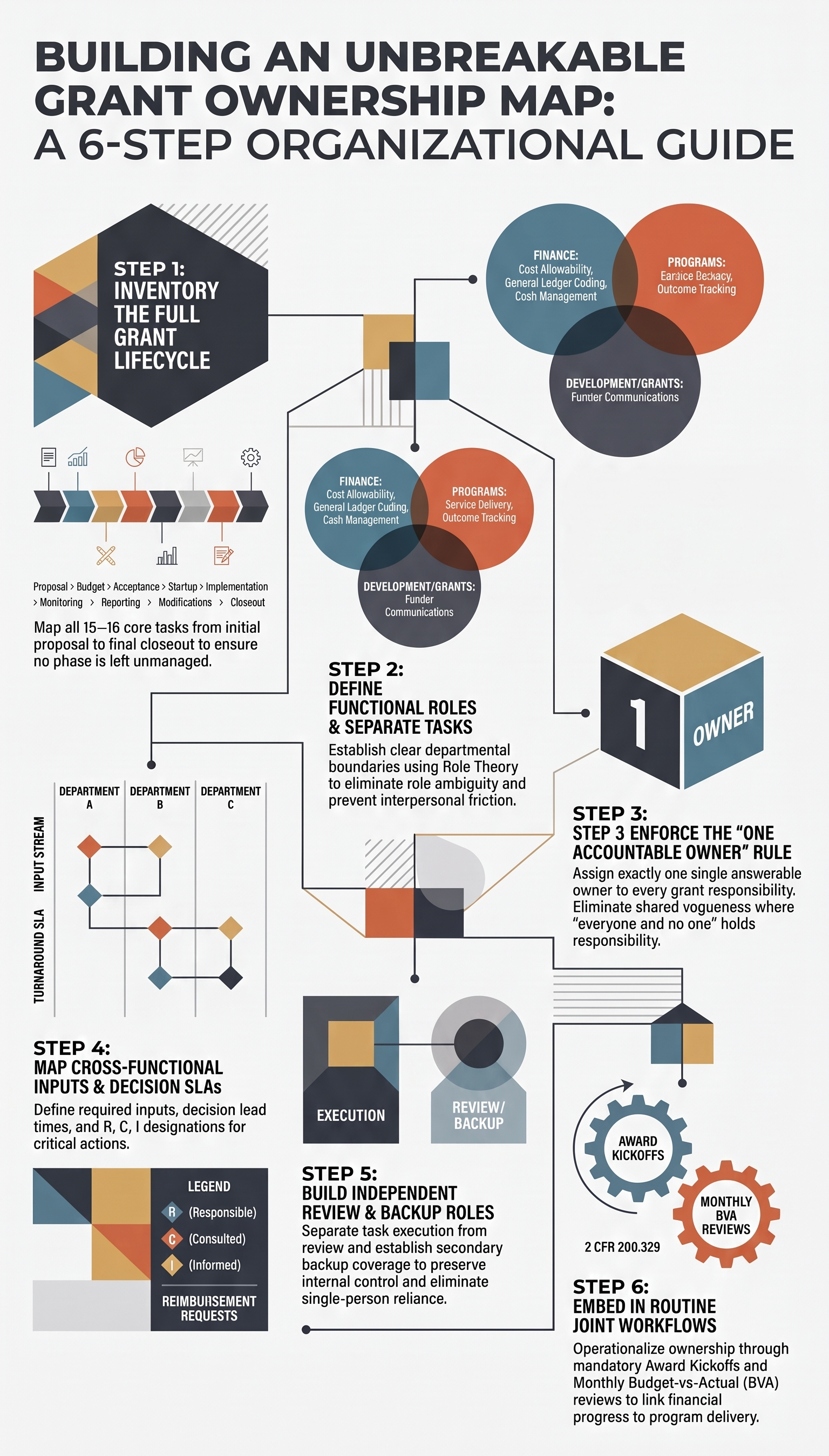
This six-step guide helps your team turn those dependencies into a working agreement. The infographic is the visual overview; the steps below explain how to apply it to one grant.
The six steps
1. Inventory the full grant lifecycle
List the work required to move one grant from opportunity to closeout. Include proposal development, budget preparation, award review and acceptance, startup, implementation, monitoring, reporting, modifications, and closeout. Break broad categories into the actual tasks your team carries out.
For example, "reporting" might include collecting service data, checking expense records, drafting the narrative, reviewing the complete report, and submitting it. Give each task its own row when it needs a different owner or deadline.
Write down: the task, expected output, due date, and any information or decision needed before work can begin. Use the tasks your award actually requires rather than aiming for a fixed number of rows.
2. Define functional roles and separate tasks
Ask what each function contributes before assigning names. Finance may prepare financial information and review budget coding. Programs may document service delivery and outcomes. Development or grants staff may coordinate funder communications and submissions. Leadership may hold approval authority for particular commitments.
In a small organization, one person may hold several roles. Make those roles visible anyway, so the team can see where workload, authority, or review coverage needs attention.
Discuss: What does each function prepare, review, decide, and communicate? Where are two teams assuming the other is handling the same task?
3. Name one accountable owner for each responsibility
Choose one person who is answerable for moving each task to completion. That person coordinates the contributors, checks progress, and raises a concern when the task is blocked. Accountability does not mean doing every part of the work alone.
Use a simple legend: A is accountable for completion, R does the work, C provides input before an action or decision, and I needs to be informed. Review and approval authority should be recorded explicitly; an accountable owner does not automatically have permission to approve every decision.
Check: Can everyone name the owner, and does that person have the authority, time, and support needed to carry the responsibility?
4. Map inputs, handoffs, and decision timelines
For each handoff, agree on what must arrive, in what format, and by when. Set internal deadlines that leave room for checking, questions, and corrections before the funder's deadline.
If you use the term "service-level agreement," keep it practical: it is the team's agreement about a handoff or turnaround time. Record how to flag incomplete information, who resolves a delay, and when to escalate a decision.
Make it concrete: "Programs sends the reviewed participant totals in the shared reporting template by the internal cutoff" is easier to act on than "Programs supports reporting."
5. Build review and backup coverage
Identify who checks the work and who can step in when the primary owner is unavailable. Where feasible, separate preparation from review, especially for financial information and consequential decisions. If staffing is limited, identify an appropriate additional reviewer rather than assuming a second department exists.
A backup needs access to current instructions, files, deadlines, and the right permissions. Naming a backup without preparing that person leaves the same dependency in place.
Test: Could the backup find the latest report, understand what remains open, and explain the next deadline without relying on the primary owner's memory?
6. Embed the map in routine coordination
Use the map during award startup and revisit it in regular finance-program check-ins. A budget-to-actual review can help teams discuss spending alongside delivery progress, upcoming commitments, and unresolved decisions.
Choose a review rhythm that fits the award and your team. Update the map when staffing, scope, deadlines, or responsibilities change. End each review with named actions and dates, so the map continues to support daily work.
Keep visible: the current version, open decisions, upcoming handoffs, and who will follow up.
What one row could look like
This is a hypothetical example, not an EBS client result or a required staffing model. Adapt the assignments and timing to your award, approval rules, and available staff.
| Task | Accountable owner | Contributors and inputs | Review and backup | Internal timing |
|---|---|---|---|---|
| Coordinate the quarterly grant report | Grants lead | Programs provides reviewed service totals and narrative; finance provides reviewed financial information | Authorized reviewer checks the complete report; a designated backup can access the files and submission instructions | Agree on separate input, review, and submission dates before the funder deadline |
For a small team, replace department names with the actual people performing those functions. If different parts of the report have separate owners or approval requirements, give them separate rows.
Start with one grant
Bring the people responsible for program delivery, financial information, funder communication, and approvals into the same conversation. Use the Grant Ownership & Decision-Rights Worksheet to capture your first draft.
- List the tasks from proposal to closeout.
- Assign one accountable owner to each row.
- Name the contributors and required inputs.
- Record review, approval, and backup coverage.
- Set internal handoff dates and an escalation path.
- Choose when the team will review and update the map.
Test the draft against your next real reporting cycle. Notice where staff still need to ask who decides, where information waits, or where the backup cannot continue the work. Use those observations to refine the map.
A coordination tool, not a compliance guarantee
The guide supports clearer ownership and working routines. It does not replace your award terms, organizational policies, approval requirements, or qualified grant-compliance advice. Kickoffs and monthly budget-to-actual reviews are suggested management practices here, not a statement that every award requires that exact meeting schedule.
Keep building the system around the grant
- Use the companion ownership worksheet to record assignments and decision boundaries.
- Explore grant readiness after an award to consider the operational support funded work needs.
- Explore Systems and Process Design for support turning responsibilities into shared workflows and practical tools.
- Tell EBS about your grant coordination priority if your team would benefit from help mapping the work together.